
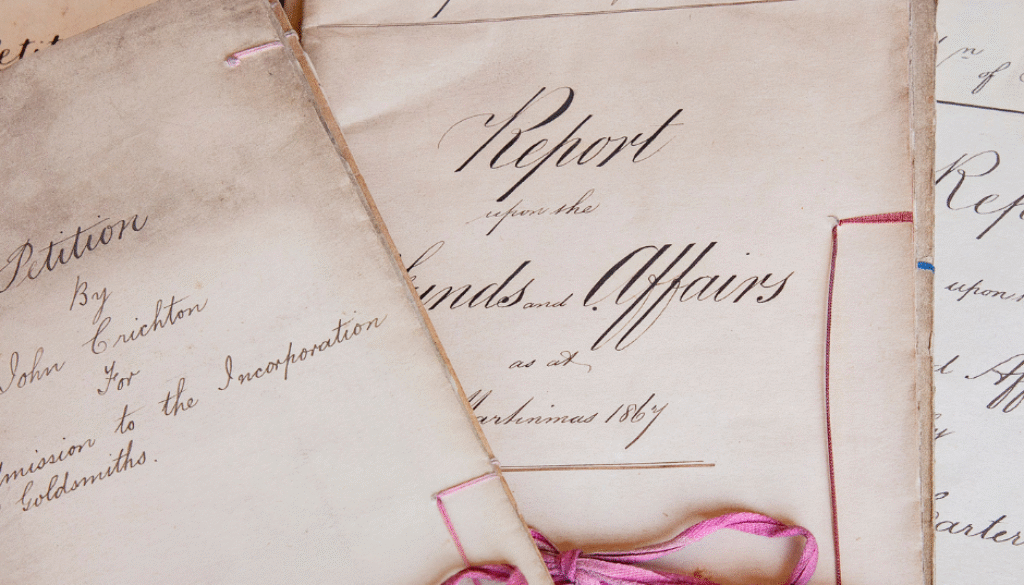
The Lovable Craft: The Early History
Over the coming months, we’re looking forward to sharing more of Edinburgh Assay Office’s long history.
Here is an excerpt from a booklet entitled ‘The Loveable Craft,’ written in 1987 to mark the 300th anniversary of the Incorporation of Goldsmiths’ grant of Royal Charter in 1687.
Written by George Dalgleish and the late Stuart Maxwell, this covers the extensive history of the Incorporation and hallmarking in Edinburgh. Maxwell served as a Warden for the Incorporation of Goldsmiths for many years in addition to a long and celebrated career as an expert in Scottish history and antiquities. Dalgleish is one of the Incorporation of Goldsmiths longest-serving members, bringing a wealth of expertise on silver from his former role as Keeper of Scottish History & Archaeology at the National Museum of Scotland.
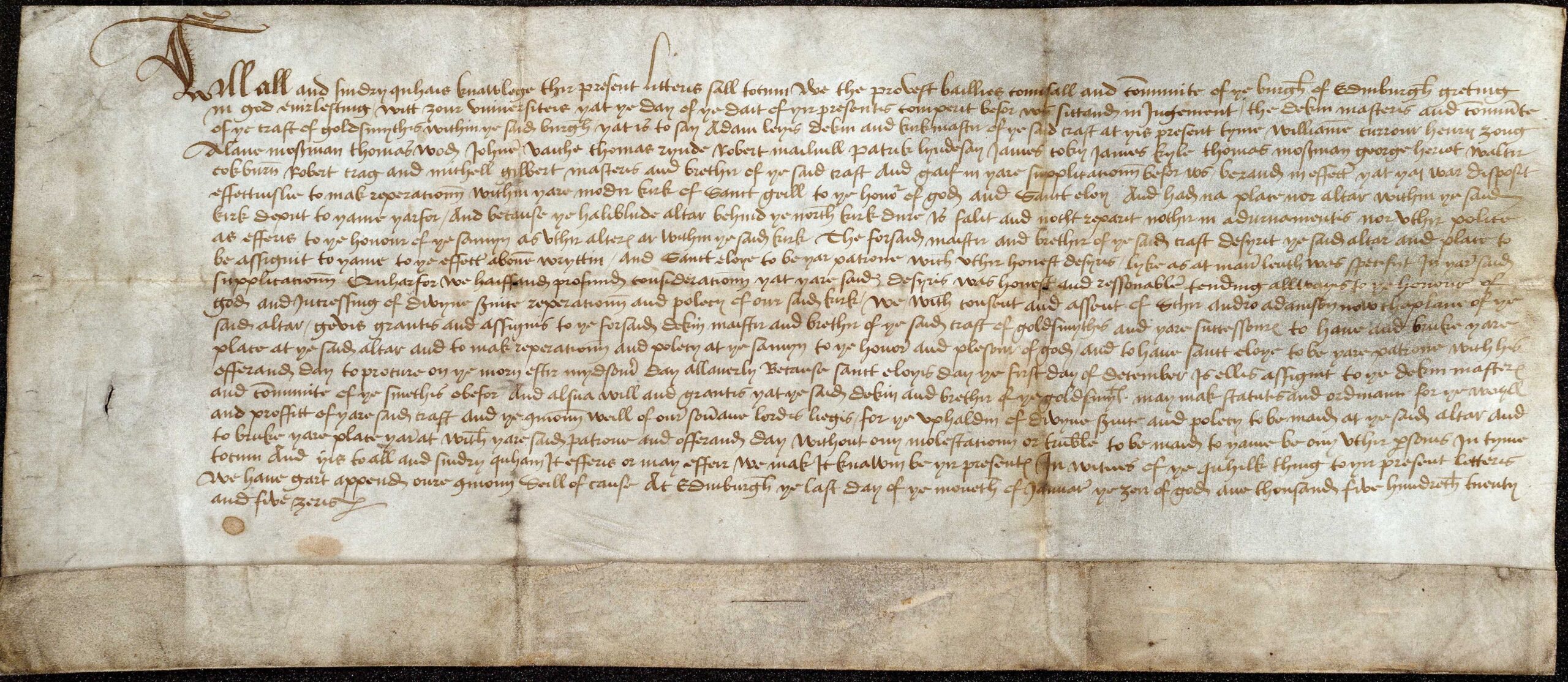
‘The Incorporation’s history did not begin in 1687. The goldsmiths were originally hammermen, ‘workers with hammer and hand’ who specialised in making articles from the precious metals, gold, and silver, in the same way as the blacksmiths worked in iron and the pewterers in pewter.
In 1483 the Edinburgh Hammermen were granted a Seal of Cause by the Town, a document which signified that the Council recognised them as a body competent to govern themselves by the regulations contained therein, and to be trusted to conduct their business in such a way that citizens would not be harmed. With regard to this second part, the goldsmiths were a special case for they worked in the same metals as the coinage, which meant that the King was particularly interested in their conduct. Being soft, gold and silver have to be alloyed with base metals to make them more durable. Parliament set standards for gold and silver work throughout Scotland in an Act of 1457 and also put the responsibility for upholding these standards on goldsmiths in whichever town they worked. Though smaller than the other crafts in Edinburgh, it was only in the capital that there were enough of them to be an independent Incorporation.
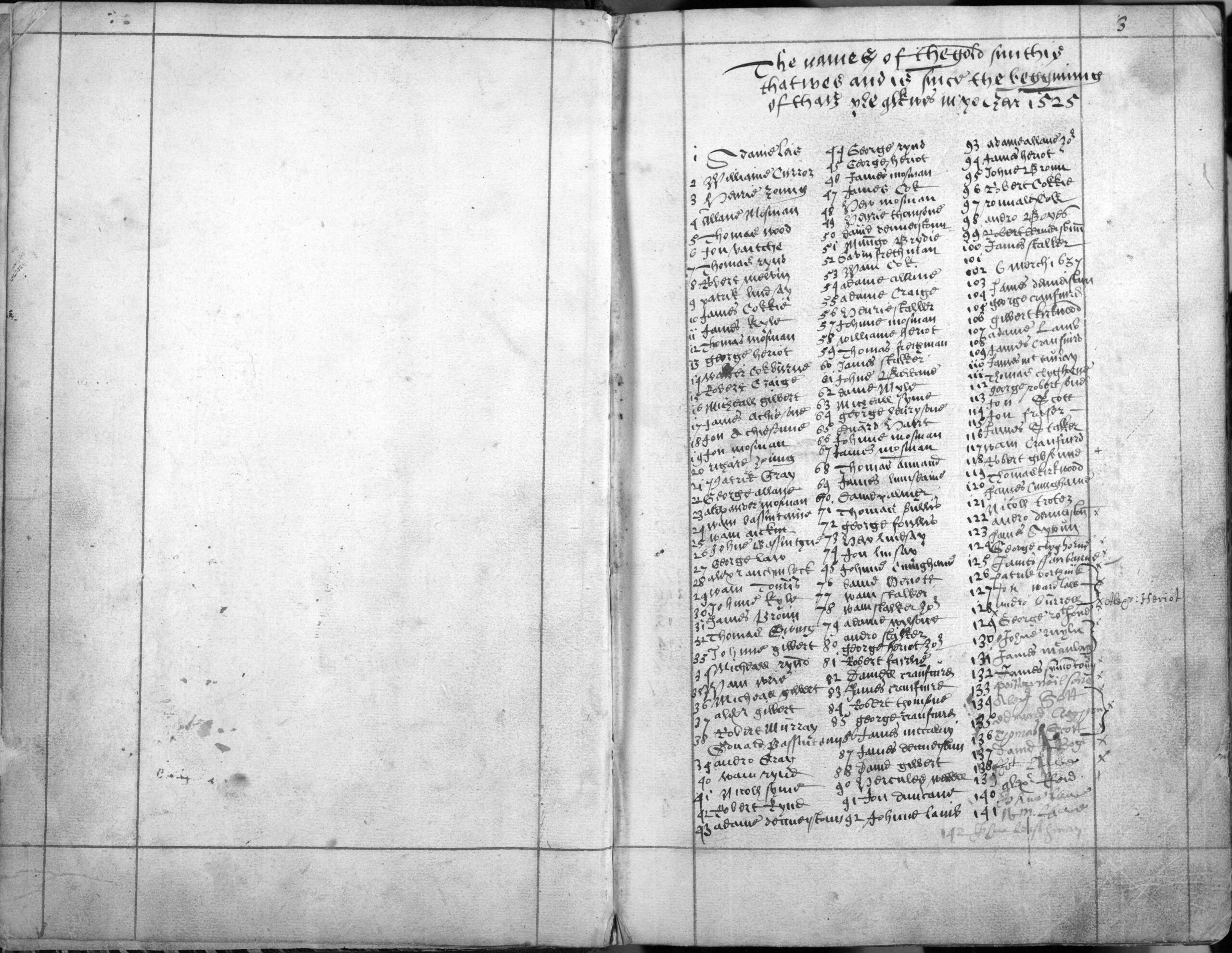
Recognition of their independence from the Hammermen probably came in 1525, when their earliest minute book begins. An act of the Town Council followed in 1526, granting the deacon and masters responsibility for the care of St Eloi’s altar in the High Kirk of St Giles; St Eloi was the patron saint of goldsmiths. The names of the sixteen masters listed in this document are identical with those appearing at the beginning of the first minute book (left). Their Seal of Cause, however, was lost in a fire and their minutes record, in 1580, that every master should write down its contents as he remembers them so that a new Seal might be obtained. But it was not until 1591 that a statue of the Town Council listed regulations for the craft similar to those in the older Seals of Cause
First, with regard to apprentices: an apprenticeship was to last not less than seven years; a master must allow three years to elapse before taking on another apprentice, so that the older apprentice was sufficiently experienced to teach the younger. The seven year apprenticeship lasted for centuries and the craft clung doggedly to the three year rule in the mid-eighteenth century, even when it meant hardship for a master who had lost an apprentice by death or desertion. No one could become a master, a freeman of the Incorporation, unless he fulfilled the following conditions: he had served the seven years apprenticeship with a freeman’s burgess, in the case of a burgess’s son followed by one year as a journeyman, or if he was a ‘stranger’ two years–the interval was later increased to three years, but might be dispensed with on payment of a fine. As well as being ‘of guid lyfe and conversatioun [good life and conversation]’ the qualified journeyman had to own £500 in goods and land, or have ‘caution’, or surety, for that amount. As the seventeenth century progress the actual sum was forgotten and only the cautioner’s signature to the record int he minute book remained. The applicant had to pay a fee to the Incorporation, and finally, had to make ‘ane sufficient assay, pruif and tryall… of his cunnyng and experience baith in workmanship and knowledge of the fineness of metills [a sufficient assay, proof and trial… of his cunning and experience both in workmanship and knowledge of the fineness of metals’. In other words he was given an essay, usually two items, to make in a designated shop in the presence of two masters (often an old and a young master) whom he had to satisfy. Essays should not be confused with assays, the taking by the deacon, later the assay master, of a trial sample of metal from an object made by a goldsmiths, which was tested to prove the quality of the metal. They are spelled the same way in the minutes.
The Incorporation had the power to search out and destroy the work of anyone who was not a master or in a master’s employ, and to imprison the offender until a fine was paid. This was, of course, normal practice–the ‘closed shop’ of the Middle Ages. For the next two centuries, the Edinburgh Goldsmiths fought a losing battle against the ‘unfree’ goldsmiths of the ‘suburbs’ and against the organised goldsmiths of the Canongate, then a separate burgh.
Other regulations included the prohibition of working in base metals or the gilding of such work, and the taking of one master’s servant by another master; ‘all servands sall work for meit and fie [all servants shall work for meat and fee]’. The word ‘servant’ is nowhere defined. Sometimes it appears to include all those working for a master, at other times it specifically refers to a nondescript, unrecognised class, neither apprentices nor journeymen, men engaged without being entered in the books as apprentices and who therefore had no chance of ever becoming journeymen, far less freemen and masters. In the early days they were in a better position. In 1529, they were bound to a master for one year; the agreement had to be witnessed by two other masters, and if they were idle for eight days the deacon had to find work for them, within the craft and within the town. But what was forbidden by statute, often actually happened; their position does not appear to have improved and in later years these provisions are never mentioned.
The deacon was chosen annually but could remain in office for more than one year at a time. He was very much the leader of the craft; he presided at their meetings, was their representative in the Convenery of Incorporated Trades, and it was the deacon who assayed gold and silver and marked it with his own and the town’s mark as a guarantee that it was of the required standard of fineness. An early deacon complained about having to follow the King around the country to plead the craft’s cause–and about the money he had to pay the various courts! The goldsmiths’ booths were inspected weekly by the deacon and two masters, and he had to investigate complaints about the late delivery of work. ‘Yince a deacon, aye a deacon [once a deacon, always a deacon]’, the title was retained when the period of office came to an end and old deacons were natural choices for the many committees the Incorporation formed in the eighteenth century. Six deacons of the Incorporated Trades were chosen each year, from the late seventeenth century, to be members of the Town Council. The Goldsmiths, who formed the elite of the craft guilds along with the Surgeon Apothecaries, had their full share and more of the council membership.
Before the Union of 1707 goldsmiths served both as members of Parliament and as representatives of the City on the Convention of Royal Burghs. During most of the eighteenth century there were some thirty masters alive at one time, more than in the previous century. Perhaps a quarter of them had been deacon, others had been the treasurer, boxmaster or quartermasters so there was always a number of masters accustomed to holding office, to speaking and voting, also versed in all the political arts, respectable and otherwise.
In 1586 James VI empowered the Incorporation ‘to searche and trye that all gold and silve wark wrocht and maid in ony pairt within this realme be of the fyness conforme to the actis of parliament maid thereupon [to search and test that all gold and silver work wrought and made in any part within this realm be of the fineness conformed to the act of parliament made thereupon]’; this power over goldsmiths outside Edinburgh was embodied in an Act of Parliament of the next year.
We’ll be sharing more of this book in the coming weeks, covering the long history of The Incorporation of Goldsmiths of the City of Edinburgh!