
Hallmarking Services
Perfect hallmarks every time
As an Assay Office, our primary service is to guarantee the purity of precious metals by assaying and hallmarking articles of gold, silver, platinum and palladium. Our hallmarking services ensure items are in compliance with both national and international regulations.
We have been hallmarking since our establishment in 1457. With over 560 years of experience, we are trusted to provide this important regulatory function. Our stakeholders expect us to deliver high-quality and consistent results while operating independently and with unquestionable integrity. We focus on making the hallmarking process as easy as possible for everyone requiring a hallmark. We are committed to a process of continuous improvement and pride ourselves on the quality of our work and innovations. These ensure our important regulatory function continues to add value for our stakeholders.
Edinburgh Assay Office has developed the equipment, the expertise, the culture and the systems to deliver high-quality marks every time. Every product we mark is returned in the same condition that it is received.
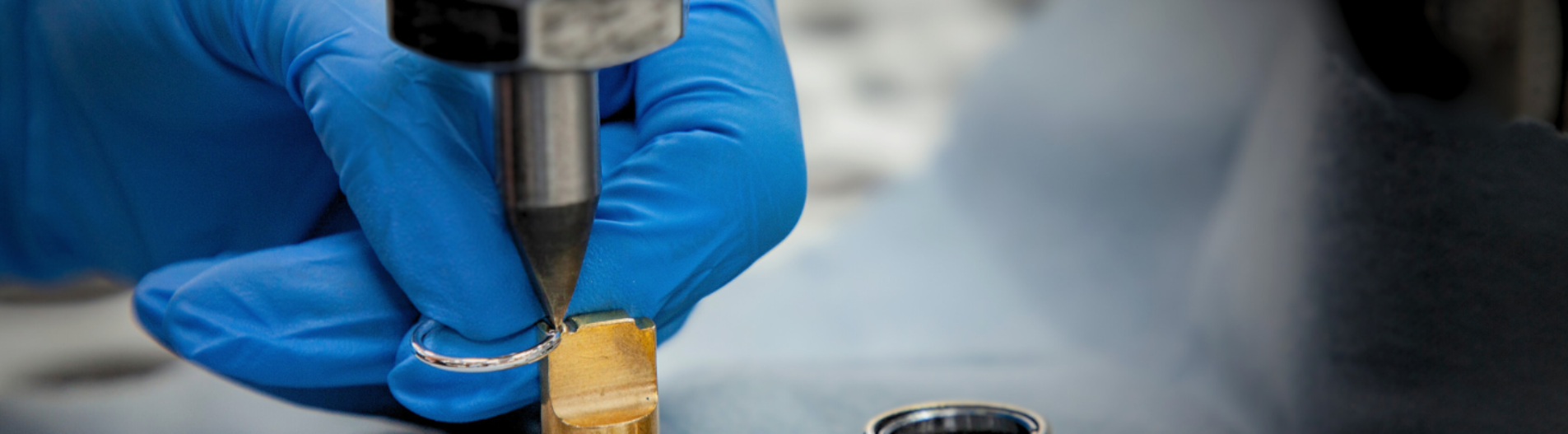
We offer a range of hallmarking services, including traditional artisanal handmarking, automated press machine marking and the latest, non-contact laser hallmarking. Additionally, we use non-destructive testing technologies, ensuring items are returned in a flawless condition.
Read below to understand our internal quality control principles for hallmarking: the 5 P’s of a Perfect Hallmark.

Types of Hallmarking at Edinburgh Assay Office
Hallmarking by Hand
Hallmarking by hand is the traditional form of applying a hallmark, carried out by punch and hammer. We pride ourselves on our large feature marks applied to traditional silverware, and we continue to use hand marking on jewellery at all stages of manufacture. For finished jewellery, the compromise is that the mark is normally small and lightly applied using specialist supports to eliminate any bruising or distortion.

Hallmarking by Automated Press Machine
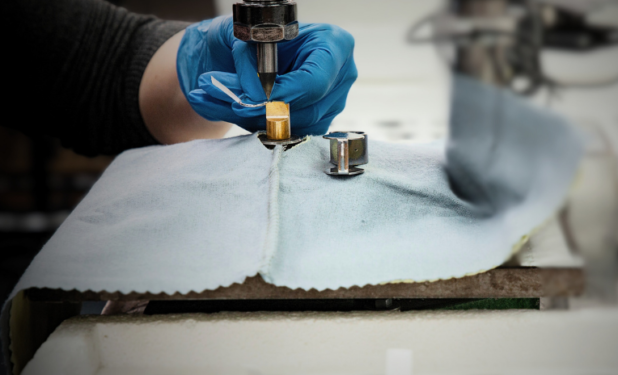
Our high-speed hydro-pneumatic presses are used with custom supports and matching punches to produce perfect, consistently positioned hallmarks on higher volumes of like product. Our engineering workshop can produce custom tooling and punch solutions to ensure the finished jewellery can be marked with zero distortion or bruising. This ensures high-speed application with excellent repeatability and unwavering quality.
Hallmarking by Non-Contact Laser
Laser marking can be applied to any item at any stage. It is particularly useful for items that are hollow or so light that a contact mark is not possible. This type of marking also allows for larger marks to be applied in areas that would not be possible by contact marking. Due to the time taken to set up our lasers for custom marks and the cost the equipment itself, laser marking normally costs more than contact marking. This is especially the case for small batches, where set-up times are proportionally higher.

Online Registration
Register with Edinburgh Assay Office to begin your hallmarking journey.