
From Quill Pen to QR Code
600 Years of Traceability at the Heart of Hallmarking
A member of the public recently approached Edinburgh Assay Office with a piece of silver and a simple request: could we identify it?
As with all hallmarking enquiries, the answer lay in the marks themselves.
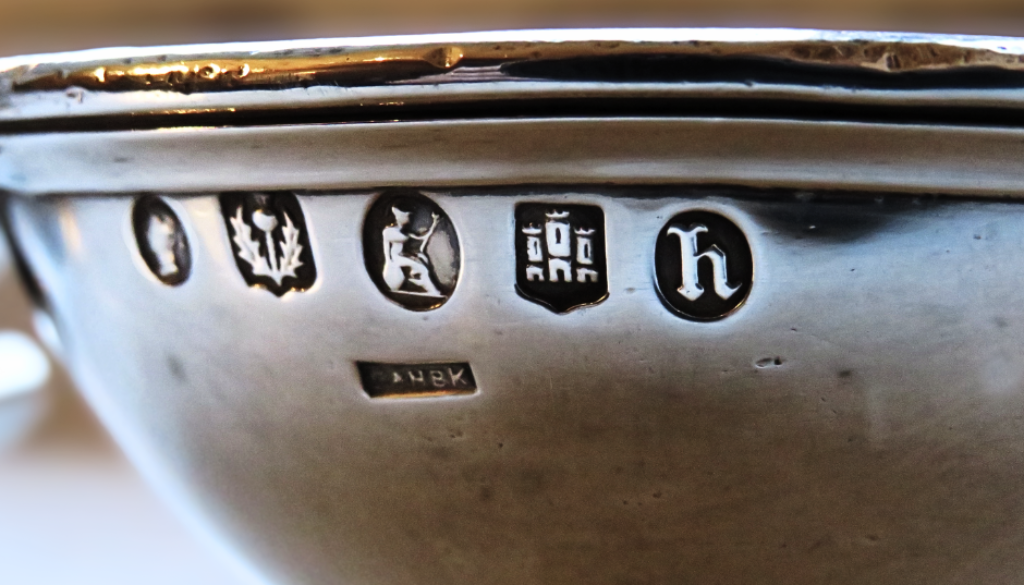
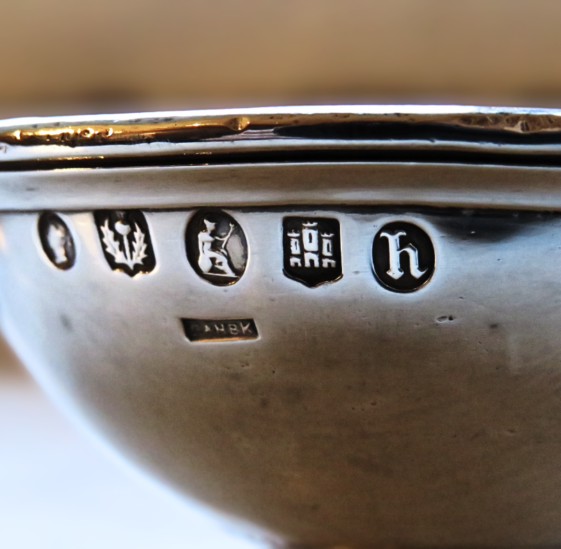
By examining the hallmark, specifically the maker’s mark and the date letter, we were able to identify both the silversmith and the year in which the object was assayed. These marks, applied one hundred and thirty six years ago, remain legible, authoritative and verifiable today. That alone is a powerful demonstration of the enduring strength of the hallmarking system.
However, this particular piece had more to reveal.
Alongside the standard hallmarks, there was a distinctive engraving linking the object to a historically significant moment, the final day on which the Edinburgh Assay Office applied the duty mark. From our records, we know that duty collection ended on 30 May 1890.
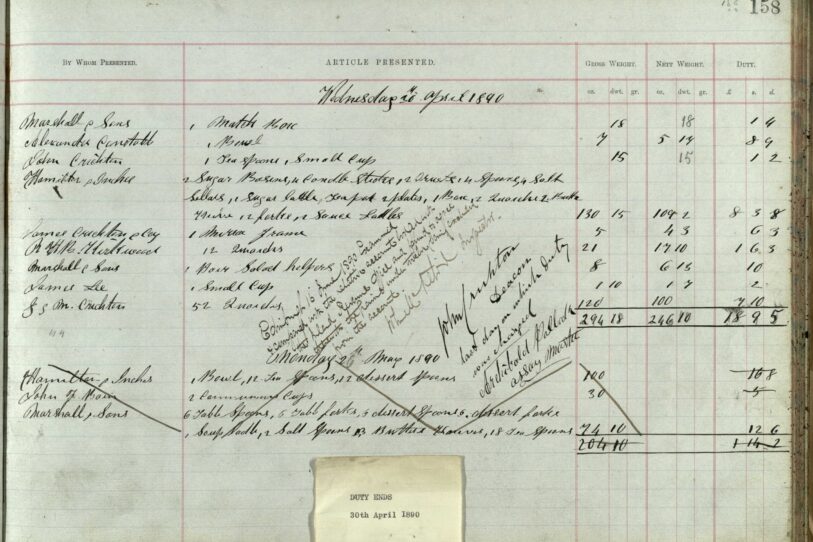
With that knowledge, our records team located the exact page within one of our leather bound day books. These handwritten registers, recorded in quill pen, document the testing and hallmarking of every item submitted. On 30 May 1890, twelve silver quaiches were assayed and marked.
The entry confirms that these quaiches were made from silver assay scrapings and presented to members of the Incorporation of Goldsmiths of the City of Edinburgh to commemorate the end of duty collection and the discontinuation of the duty mark as part of the assay and hallmarking process.
From a single piece of silver, we were able to move from physical marks to a precise date, to a handwritten archival record documenting its creation and purpose.
This is traceability in its purest and oldest form.
Hallmarking: An Early System of Traceability
Today, traceability is frequently discussed as a modern challenge. Consumers increasingly demand transparency around product origins, materials and supply chains. Regulators are introducing new requirements for provenance, accountability and disclosure. In response, manufacturers and retailers are investing heavily in supply-chain mapping, digital passports and traceability platforms, creating an entire ecosystem of technologies and service providers.
It is easy to overlook a simple truth: hallmarking has been doing this for centuries.
For nearly 600 years, Edinburgh Assay Office has operated on a consistent principle:
- independently verify factual claims,
- record those facts at the point of testing, and
- apply permanent marks that link the physical object to those records.
The hallmark is not decoration, nor is it simply a legal requirement, or a quaint tradition. It is it’s a corner stone. A promise of independent assessment and control. It’s an immutable statement of verified fact, carried with the object for life.

Data Sovereignty in a Digital Age
Our commitment to transparency did not end with the handwritten register.
Edinburgh Assay Office has always maintained and controlled its own records. Data sovereignty is the principle that verified information remains under the stewardship of the independent body that created it. It has long been a cornerstone of our assurance model. We do not outsource our archives. We do not relinquish custodianship of verified facts. The integrity of the system depends on it.
In recent years, we digitised our historical registers, enabling authorised users to search hallmarking records independently and connect physical objects to archival evidence with unprecedented efficiency. The medium changed; the governance did not. The data remains independently held, curated and protected.
But independence does not mean isolation.
In 2025, Edinburgh Assay Office launched the SmartMark pilot, extending traditional hallmarking into the evolving digital traceability landscape. SmartMark introduces the ability for each hallmark to be paired with a unique alphanumeric identifier. That identifier can be:
- securely linked to an existing Digital Product Passport (DPP), or
- discreetly laser-marked onto the article and searched through an Edinburgh Assay Office portal.
Crucially, this does not centralise supply-chain data within the Assay Office, nor does it require brands to abandon their existing systems. Instead, SmartMark functions as an independent, trusted anchor point, connecting the physical hallmark to digital records through secure APIs and interoperable architecture.
This approach reflects a deliberate strategy. As regulatory frameworks such as Digital Product Passports evolve and as Web3 technologies reshape expectations around decentralisation, interoperability and verifiable data, we are preparing accordingly. By making hallmark data API-accessible and DPP-ready, while maintaining data sovereignty, we are ensuring that independent assurance remains relevant within a distributed digital ecosystem.
The hallmark was never just a mark. It was always a controlled, verifiable data point. SmartMark simply allows that data to participate securely in modern digital environments without compromising independence.
This builds naturally on Edinburgh Assay Office’s longstanding governance role, including projects like auditing and managing the Scotgold’s trial Scottish Gold Traceability Scheme.


Immutable Facts, Enduring Trust
The lesson from that single piece of silver was clear.
Traceability, transparency and provenance are not new concepts. They have always been foundational to hallmarking. For centuries, Edinburgh Assay Office has diligently recorded verified facts and permanently linked them to individual objects, retaining custody of the data, standing behind its accuracy, and ensuring it remains accessible.
Technologies evolve. Platforms change, but trust continues to depend on the same thing it always has; independently verified facts, sovereign data anchored to the physical object.
Immutable facts build enduring trust.